Choosing between Google Display & Video 360 and an independent DSP is not really a question of which platform is “better.” It is a question of which platform architecture fits the inventory, data, identity, targeting, workflow and measurement your campaign actually needs.
Last verified: September 10, 2026. Platform capabilities, inventory access, identity solutions and commercial models can change. Vendor-specific claims in this guide were reviewed against current first-party product documentation.
DV360 is tightly connected to Google’s advertising and measurement ecosystem and is particularly relevant when YouTube, Connected TV, premium programmatic deals and enterprise campaign operations matter.
Independent DSPs such as StackAdapt, Simpli.fi, Adform and The Trade Desk take different approaches. Some emphasize streamlined self-service. Some specialize in location and household activation. Others focus on multi-ID identity, open-internet buying, retail data or omnichannel media operations.
Quick answer: Choose DV360 when YouTube, Google ecosystem integration, enterprise programmatic workflows and cross-channel planning are central to your strategy. Consider an independent DSP when your priorities include a different self-service model, specialized geo-targeting, open-internet identity, retail data, specific supply relationships or platform flexibility outside Google’s ecosystem.
Methodology
This comparison uses current public product documentation from Google Display & Video 360, StackAdapt, Simpli.fi, Adform and The Trade Desk.
The platforms are compared across:
inventory and channel support;
Connected TV;
identity and first-party data;
local and addressable targeting;
workflow and operational complexity;
measurement and reporting;
pricing and access considerations.
This is not a claim that every feature is enabled in every market, account or contract. Availability can depend on geography, advertiser eligibility, inventory source, partner access, publisher deal and commercial agreement.
DV360 vs independent DSPs at a glance
Platform | Documented strength | CTV | Identity / data approach | Local / addressable focus | Best fit |
|---|---|---|---|---|---|
DV360 | Google ecosystem + enterprise programmatic buying | Strong | Google, first-party and partner data | Regional and geographic targeting | Enterprise advertisers, agencies, YouTube + CTV |
StackAdapt | Accessible multi-channel programmatic workflow | Strong | First-party, contextual and platform data | Broad geo targeting | Mid-market teams and agencies |
Simpli.fi | Addressable and location-based programmatic | Strong | Household, addressable and location signals | Core specialization | Local, multi-location and household campaigns |
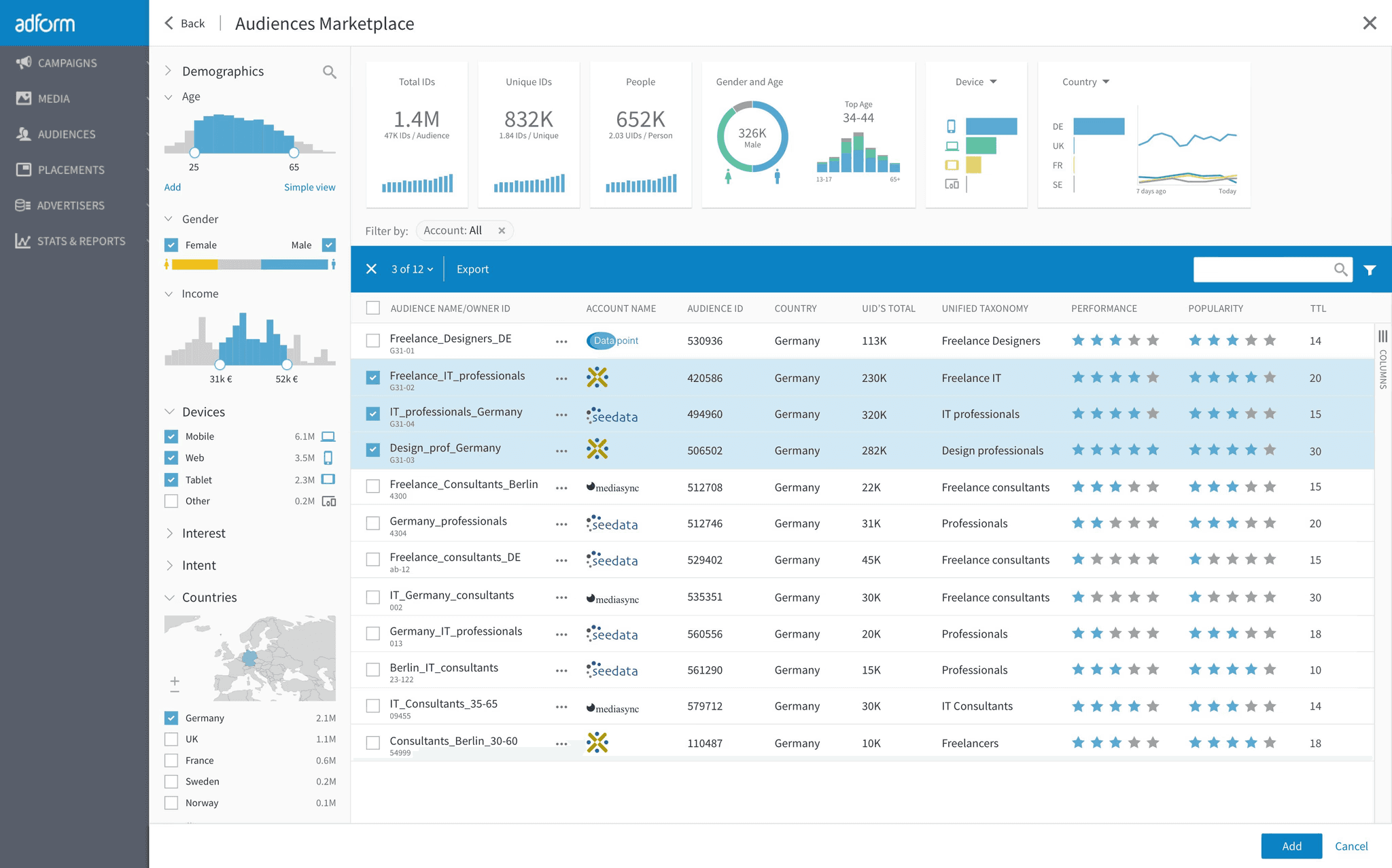
Adform | Omnichannel buying + multi-ID identity | Strong | ID Fusion / multi-ID framework | Broad omnichannel targeting | European/global omnichannel advertisers |
The Trade Desk | Open-internet buying + identity + retail data | Strong | UID2, EUID, first-party and retail data | Broad targeting | Large brands and agencies buying across the open internet |
The overlap between these platforms is substantial. The important differences are usually not whether a channel exists, but how inventory, identity, targeting, measurement and workflow fit together inside the platform.
What makes DV360 different?
Display & Video 360 is Google’s enterprise demand-side platform for programmatic media buying.
Its strategic value is not simply access to display inventory. It can combine Google and third-party programmatic workflows across areas such as:
YouTube;
Connected TV;
display;
online video;
audio;
private marketplace deals;
packages;
Programmatic Guaranteed and other deal workflows;
Google audiences and first-party data;
Campaign Manager 360 and Floodlight-based measurement workflows.
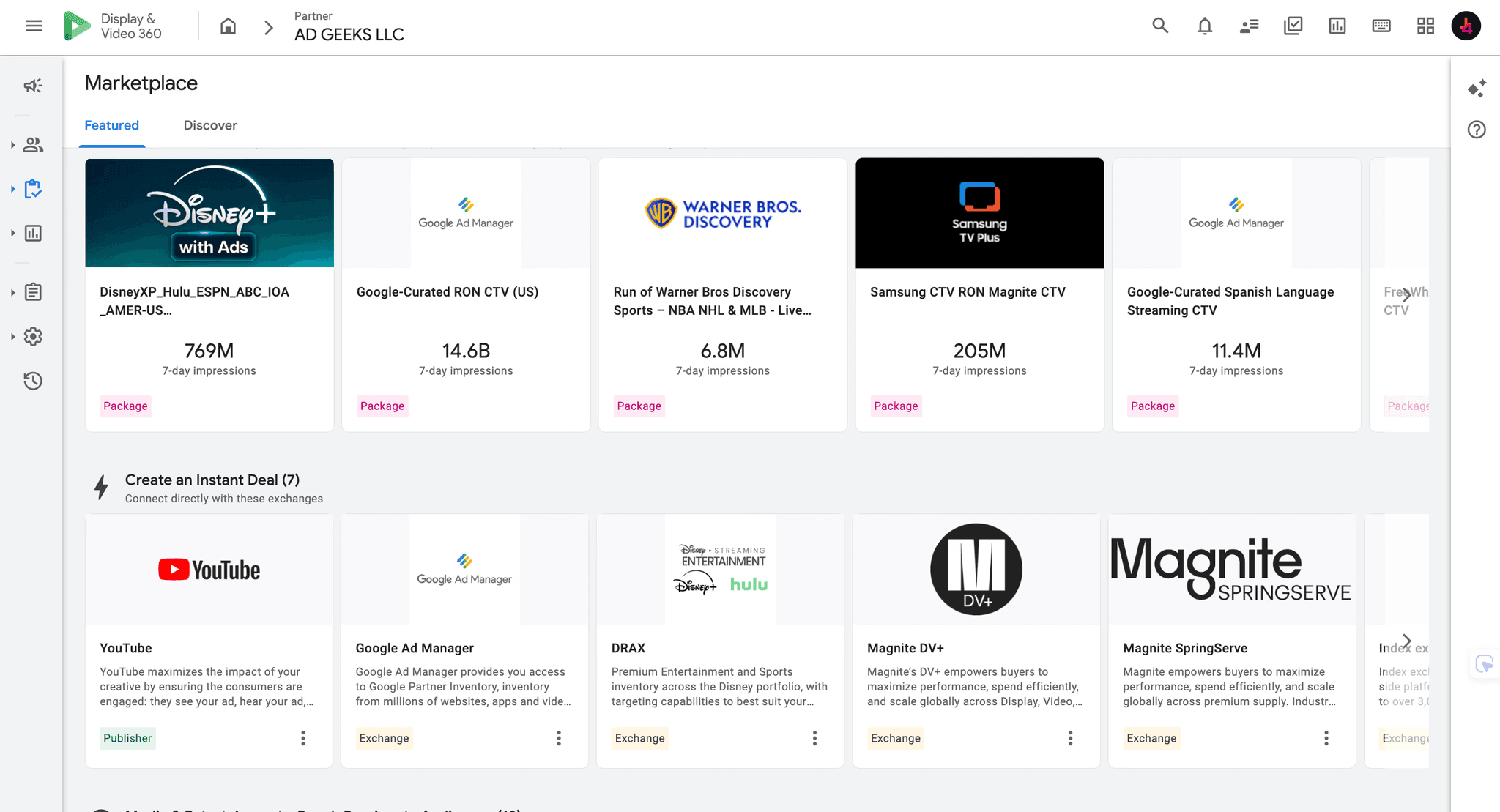
Google documents dedicated Connected TV insertion orders and line items, YouTube & partners line items, CTV inventory packages and Marketplace deal workflows.
Sources:
DV360 is therefore a strong fit when YouTube and broader programmatic media need to operate within one enterprise buying environment.
What does “independent DSP” mean?
An independent DSP is a demand-side platform whose core business is programmatic media buying rather than ownership of a major consumer advertising ecosystem such as Google or Amazon.
That can lead independent platforms to differentiate around areas such as:
open-internet supply;
publisher relationships;
identity interoperability;
retail and commerce data partnerships;
supply-path control;
local and addressable activation;
workflow simplicity;
omnichannel planning.
But “independent DSP” is not one product category with one feature set.
StackAdapt, Simpli.fi, Adform and The Trade Desk are materially different platforms. The useful question is not “DV360 or an independent DSP?” It is:
Which platform is best aligned with the specific campaign problem?
DV360 vs StackAdapt
StackAdapt positions itself as a multi-channel advertising platform that unifies CTV, DOOH, display, native, audio, video and other channels in one environment.
Its public product positioning emphasizes AI-driven targeting, real-time optimization, cross-channel orchestration and self-service access.
Source: StackAdapt Plans and Packages
Where DV360 may be the better fit
DV360 is often the better fit when:
YouTube is a major part of the media plan;
Google Marketing Platform integration matters;
the team needs enterprise campaign hierarchy and governance;
premium deals and Google-linked inventory are important;
the advertiser already uses Campaign Manager 360 or Floodlight;
multi-market programmatic operations require consistent controls.
Where StackAdapt may be the better fit
StackAdapt may fit better when:
the team wants a more accessible self-service entry point;
multi-channel activation is required without a Google-centric operating model;
native advertising is important;
a mid-market or agency team values a more streamlined workflow;
the platform’s support and commercial model fit the organization better.
DV360 vs StackAdapt summary
Area | DV360 | StackAdapt |
|---|---|---|
YouTube | Native DV360 buying workflow | Not a substitute for DV360 YouTube buying |
CTV | Yes | Yes |
Display | Yes | Yes |
Native | Available through programmatic inventory | Core promoted channel |
Audio | Yes | Yes |
DOOH | Yes | Yes |
Workflow | Enterprise / more layered | Positioned as more streamlined |
Best fit | Enterprise and Google-integrated teams | Mid-market and self-service-oriented teams |
The distinction is less “enterprise versus simple” and more which operating model your team can use effectively.
DV360 vs Simpli.fi
Simpli.fi is the most specialized platform in this comparison for addressable and location-based activation.
Its current product documentation describes Addressable Geo-Fencing as a workflow that converts street addresses into property-level geographic fences and can deliver mobile, video and CTV advertising to devices associated with those locations.
Simpli.fi also positions its CTV product around household-level audience targeting, ZIP-level planning, location intelligence and offline attribution.
Sources:
Where Simpli.fi may be the better fit
Simpli.fi is particularly relevant when the strategy depends on:
household address lists;
CRM address activation;
individual property boundaries;
store-level or dealership campaigns;
multi-location businesses;
local trade areas;
foot-traffic attribution;
household-level CTV planning.
This is a specialized capability set. It should not be described as identical to DV360’s native geographic targeting.
Where DV360 may be the better fit
DV360 may fit better when:
YouTube is important;
the campaign spans multiple markets;
CTV is one part of a broader enterprise programmatic plan;
private deals and premium publisher inventory matter;
the advertiser uses Google’s wider measurement ecosystem;
large-scale campaign governance matters more than property-level address activation.
DV360 vs Simpli.fi summary
Area | DV360 | Simpli.fi |
|---|---|---|
CTV | Strong enterprise workflow | Strong, with location and household positioning |
YouTube | Native buying workflow | Not a replacement for DV360 YouTube buying |
Geo targeting | Regional, ZIP/postal and supported geographic targeting | Specialized geo-fencing and addressable workflows |
Household address activation | Not equivalent to Simpli.fi’s native addressable product | Core documented capability |
Offline / foot-traffic use cases | Available through measurement ecosystem and partners | Strong product focus |
Best fit | Enterprise programmatic plans | Local, addressable and multi-location campaigns |
If household-level or local CTV is the central question, read the CTV Geofencing Guide.
DV360 vs Adform
Adform is one of the closest platforms in this comparison to DV360 in terms of broad omnichannel scope.
Adform’s current DSP page says campaigns can run across:
display;
video;
Connected TV;
audio;
mobile;
digital out-of-home.
It also promotes Campaign Planner and Adform IQ as part of one omnichannel workflow.
Source: Adform Demand Side Platform
Adform ID Fusion
Identity is a major part of Adform’s positioning.
Adform currently states that ID Fusion supports 45+ identifiers inside one framework, with the goal of increasing addressable reach and supporting unified frequency control across fragmented identity environments.
Because vendor identity counts can change, this number should always remain tied to the live Adform source rather than presented as a timeless platform fact.
Where DV360 may be the better fit
DV360 may fit better when:
YouTube is strategically important;
Google Marketing Platform integration matters;
Google audience workflows are central;
Campaign Manager 360 is already part of the stack;
the organization is deeply embedded in Google’s media infrastructure.
Where Adform may be the better fit
Adform may fit better when:
a multi-ID identity framework is a major requirement;
European media markets are strategically important;
DOOH is part of the programmatic plan;
a combined omnichannel buying and ad-serving environment is preferred;
the organization wants a platform positioned around multi-ID activation rather than one ecosystem.
DV360 vs Adform summary
Area | DV360 | Adform |
|---|---|---|
YouTube | Native DV360 workflow | Not equivalent |
CTV | Yes | Yes |
Audio | Yes | Yes |
DOOH | Yes | Yes, with dedicated workflow |
Identity | Google + first-party / partner ecosystem | ID Fusion / multi-ID framework |
Ad serving | Campaign Manager 360 integration | Adform platform ecosystem |
Best fit | Google-integrated enterprise teams | Omnichannel and multi-ID strategies |
For the commercial side, see Adform DSP Pricing 2026.
DV360 vs The Trade Desk
The Trade Desk is a large independent DSP built around buying across the open internet.
Its current product pages emphasize:
premium omnichannel inventory;
Connected TV;
first- and third-party data;
UID2 and EUID identity solutions;
retail data;
measurement;
AI-supported campaign optimization.
Sources:
Kokai Zuma in 2026
On August 27, 2026, The Trade Desk introduced Kokai Zuma, a new release of Kokai focused on a more intuitive interface, agentic AI capabilities and simplified measurement workflows.
The company states that Zuma is rolling out globally to Kokai clients, with some features generally available and others in open or closed beta.
Source: The Trade Desk - Kokai Zuma
UID2, EUID and identity
The Trade Desk positions Unified ID 2.0, European Unified ID and its cross-device graph as tools for privacy-conscious audience activation and measurement across the open internet.
The strategic point is not that one identity product is universally “better,” but that The Trade Desk’s identity strategy is explicitly built around interoperability outside third-party cookies.
Retail data
The Trade Desk also promotes a large retail-data marketplace, allowing advertisers to activate retail partner data and connect media investment to online and in-store sales.
That can matter when commerce and purchase signals are central to the media strategy.
Where DV360 may be the better fit
DV360 may fit better when:
YouTube is a major requirement;
Google audiences matter;
Campaign Manager 360 and Floodlight are central to measurement;
the advertiser already uses Google Marketing Platform extensively;
the team wants Google and third-party programmatic workflows in the same DSP.
Where The Trade Desk may be the better fit
The Trade Desk may fit better when:
the open internet is the primary buying environment;
premium CTV outside Google is strategically important;
UID2/EUID fits the identity strategy;
retail-data partnerships are important;
the advertiser wants an independent DSP as the center of its media-buying stack.
DV360 vs The Trade Desk summary
Area | DV360 | The Trade Desk |
|---|---|---|
YouTube | Major native strength | Not a substitute for DV360 YouTube buying |
Open internet | Strong | Core positioning |
CTV | Strong | Strong |
Retail data | Available through integrations and partners | Major product focus |
Identity | Google + first-party / partner ecosystem | UID2, EUID, cross-device graph |
AI | Google bidding and optimization systems | Kokai / Koa / Zuma capabilities |
Best fit | Google-integrated enterprise teams | Open-internet enterprise buying |
Inventory and supply-path differences
All five platforms can access significant programmatic inventory, but they do not necessarily access the same inventory through the same paths or agreements.
That matters because supply-path differences can affect:
publisher availability;
private deal access;
auction dynamics;
transparency;
data availability;
measurement;
cost.
DV360 combines Google-linked buying workflows with third-party programmatic inventory and private deals.
The Trade Desk emphasizes open-internet supply and publisher relationships.
Adform combines omnichannel buying with its own planning, identity and ad-serving ecosystem.
StackAdapt offers multi-channel activation through a platform designed to be relatively accessible.
Simpli.fi differentiates through location-driven and addressable activation.
The useful question is therefore not:
Which DSP has the largest inventory list?
It is:
Which supply paths provide the inventory this campaign actually needs?
Which DSP is best for Connected TV?
All five platforms support Connected TV. The difference is how CTV connects to the rest of the strategy.
Platform | CTV fit |
|---|---|
DV360 | YouTube + premium publisher CTV + deals + enterprise planning |
StackAdapt | CTV inside a streamlined multi-channel workflow |
Simpli.fi | Location, addressable and household-led CTV |
Adform | Omnichannel CTV combined with multi-ID planning |
The Trade Desk | Open-internet premium CTV, identity and retail-data integration |
There is no universal winner.
A national brand running YouTube, premium CTV and broader programmatic video may prefer DV360.
A local dealership using household/address-based targeting may find Simpli.fi more directly aligned.
A large advertiser building an open-internet CTV strategy around retail data may prefer The Trade Desk.
A European omnichannel advertiser may evaluate Adform.
A mid-market agency that prioritizes an accessible multi-channel workflow may evaluate StackAdapt.
First-party data and identity
Identity is one of the biggest areas of differentiation between DSPs.
DV360
DV360 can work with Google audience products, first-party audience inputs, publisher/deal audiences and other eligible data sources, subject to product and market rules.
Its strength is integration across Google’s wider advertising ecosystem.
StackAdapt
StackAdapt positions its product around first-party data, contextual targeting, intent-based targeting and platform audience capabilities.
Its differentiation is the way those tools sit inside its broader workflow rather than ownership of a separate industry-wide identity standard.
Simpli.fi
Simpli.fi places significant emphasis on:
CRM address lists;
property-level address data;
location signals;
household activation;
cross-device reach around addressable audiences.
That makes identity and targeting closely connected to real-world location.
Adform
Adform’s ID Fusion is designed to combine many identifier types inside one framework.
That can be useful in fragmented environments where campaigns need to work across multiple IDs and consent frameworks.
The Trade Desk
The Trade Desk’s identity stack includes:
UID2;
EUID;
cross-device identity;
first-party CRM data;
retail and data-partner signals.
Its positioning is explicitly tied to addressability and measurement on the open internet.
Which DSP is easiest to use?
There is no objective universal winner because “ease of use” depends heavily on the trader, campaign and organization.
DV360
DV360 is powerful but operationally layered.
Teams need to understand structures such as:
campaigns;
insertion orders;
line items;
creatives;
deals;
audiences;
bidding;
Floodlight and measurement.
That structure is valuable for enterprise operations, but it can create a steeper learning curve.
StackAdapt
StackAdapt is positioned around accessible self-service and multi-channel campaign management.
That can be attractive to smaller teams or agencies that do not need the same Google-centric enterprise stack.
Simpli.fi
Simpli.fi becomes particularly useful when the strategy is built around location, household targeting and offline outcomes.
Adform
Adform is an enterprise platform, but its current product positioning emphasizes one omnichannel workflow through Campaign Planner and Adform IQ.
The Trade Desk
The Trade Desk has historically served sophisticated traders. Its 2026 Kokai Zuma release specifically emphasizes a more intuitive user experience, faster workflow and AI-supported operations.
Reporting and measurement
All major DSPs provide campaign reporting. The important difference is the wider measurement environment.
DV360
DV360 can sit alongside:
Campaign Manager 360;
Floodlight;
YouTube reporting;
CTV reporting;
reach and frequency planning;
third-party measurement.
StackAdapt
StackAdapt promotes unified cross-channel reporting, real-time optimization and measurement options including brand lift, sales lift and foot traffic.
Simpli.fi
Simpli.fi emphasizes transparent reporting and location-based measurement, including store visits and offline attribution use cases.
Adform
Adform combines omnichannel campaign buying with identity and integrated platform measurement.
The Trade Desk
The Trade Desk combines platform reporting with identity, retail data, external measurement partners and Kokai’s evolving measurement tools.
When comparing platforms, do not ask only “Which dashboard looks best?”
Ask:
Which conversions can be measured?
Which identity signals support measurement?
Which reporting dimensions are available?
Can the platform separate publisher, deal, geography and audience performance?
Can media exposure be connected to the advertiser’s actual business outcome?
DV360 vs independent DSPs for agencies
Agencies often need more flexibility than a single advertiser because they manage:
multiple clients;
multiple budgets;
multiple markets;
different data environments;
different inventory needs;
different reporting expectations.
DV360 can be a strong agency platform when many clients use Google products, YouTube is important and enterprise programmatic is common.
StackAdapt may be attractive for teams that want a more accessible multi-channel self-service workflow.
Simpli.fi can fill a specialized role for local, franchise, dealership and addressable campaigns.
Adform can be relevant for European omnichannel strategies and multi-ID activation.
The Trade Desk can be attractive for large clients focused on open-internet buying, premium CTV, retail data and independent identity.
This is why some agencies use more than one DSP — but adding platforms should solve a real media problem, not simply increase the number of logins.
When DV360 is the better fit
DV360 is often the better fit when:
YouTube is strategically important;
Google Marketing Platform integration matters;
enterprise campaign controls are required;
CTV must sit alongside a wider Google/programmatic strategy;
private deals are important;
Campaign Manager 360 or Floodlight is part of the measurement stack;
the advertiser needs a consistent multi-market operating model.
When an independent DSP may be the better fit
An independent DSP may be the better fit when:
an open-internet-first strategy is preferred;
a specialized identity approach is required;
local or addressable targeting is central;
a more streamlined self-service workflow is important;
the advertiser wants different supply relationships;
retail media data is strategically important;
the organization wants less dependence on one advertising ecosystem.
When should you use multiple DSPs?
A multi-DSP strategy can make sense when different platforms solve different problems.
For example:
DV360: YouTube, Google-linked audiences, enterprise programmatic workflows.
The Trade Desk: open-internet CTV, retail data, UID2/EUID.
Simpli.fi: local and addressable household activation.
Adform: omnichannel and multi-ID planning.
StackAdapt: streamlined multi-channel activation for teams that prefer its workflow.
Using more than one DSP also creates costs:
duplicated audiences;
fragmented reporting;
more contracts;
cross-platform frequency challenges;
more operational overhead;
more difficult attribution.
Use multiple DSPs only when each platform has a clearly defined role.
For a deeper framework, read the Multi-DSP Matrix.
DV360 vs independent DSPs decision matrix
Methodology last verified: September 10, 2026. This matrix is a decision aid based on the documented strengths above, not a guarantee of universal availability.
If your priority is... | Platform(s) to evaluate first |
|---|---|
YouTube | DV360 |
Google ecosystem integration | DV360 |
Enterprise programmatic governance | DV360 |
Open-internet-first buying | The Trade Desk |
Retail data | The Trade Desk |
Addressable household activation | Simpli.fi |
Local geo-fencing | Simpli.fi |
Multi-ID activation | Adform |
Omnichannel European planning | Adform |
Streamlined multi-channel self-service | StackAdapt |
Premium CTV | DV360, The Trade Desk, Adform, StackAdapt or Simpli.fi depending on inventory and targeting needs |
There is no universal winner.
The platform should follow the media strategy.
What about pricing?
Pricing matters, but it should not be the only reason to choose a DSP.
The commercial model can vary by:
platform;
market;
partner;
service model;
media commitment;
data;
measurement;
management scope.
For a dedicated cost comparison, read DSP Pricing 2026: Fees, Minimums & Platforms Compared.
This article intentionally focuses on capability fit rather than declaring one platform the “cheapest.”
Red flags when choosing a DSP
Choosing based only on brand recognition
A well-known DSP can still be the wrong platform for the campaign.
Choosing based only on CPM
A lower CPM does not automatically mean better inventory quality, better reach or better business performance.
Assuming every DSP has identical CTV inventory
CTV supply, direct integrations, deal access and publisher relationships differ.
Ignoring identity strategy
Identity can affect audience activation, reach, frequency and measurement.
Choosing multiple DSPs without a defined role for each
More platforms can create more fragmentation rather than more performance.
Ignoring the team’s operating capability
The best platform is not useful if the team cannot configure, optimize and measure it correctly.
The bottom line
DV360 is a major enterprise DSP, but it is not automatically the right choice for every advertiser.
Its strongest use cases tend to involve:
YouTube;
Google ecosystem integration;
enterprise programmatic buying;
CTV;
private deals;
cross-channel planning and measurement.
Independent DSPs differentiate in other ways.
StackAdapt emphasizes accessible multi-channel programmatic buying.
Simpli.fi is highly differentiated around location, geo-fencing and addressable household activation.
Adform combines omnichannel buying with a multi-ID identity framework and integrated planning.
The Trade Desk focuses on open-internet buying, premium CTV, retail data and interoperable identity.
The best question is not:
“Which DSP is best?”
It is:
“Which DSP has the inventory, identity, targeting, workflow and measurement advantages this campaign actually needs?”
For some advertisers, that will be DV360.
For others, it will be an independent DSP.
For sophisticated multi-channel teams, it may be a carefully structured combination of both.
Frequently Asked Questions
Is DV360 better than independent DSPs?
Not universally. DV360 is particularly strong for Google ecosystem integration, YouTube, CTV and enterprise programmatic buying. Independent DSPs can offer different advantages in identity, open-internet inventory, geo-targeting or workflow simplicity.
What is the best alternative to DV360?
It depends on the use case. The Trade Desk is a strong enterprise open-internet alternative, Adform is strong for omnichannel and multi-ID activation, StackAdapt for accessible multi-channel buying, and Simpli.fi for local and addressable targeting.
Is StackAdapt easier to use than DV360?
StackAdapt is generally positioned around a more streamlined self-service workflow, while DV360 provides a deeper enterprise platform with greater operational complexity.
Is Simpli.fi better than DV360 for geofencing?
Simpli.fi specializes in addressable geo-fencing and household-level local activation. DV360 supports geographic and proximity targeting, but Simpli.fi has a more specialized addressable-location proposition.
Is Adform a good alternative to DV360?
Yes, particularly for advertisers that need omnichannel buying, identity flexibility, European market strength and integrated ad-serving workflows.
Is The Trade Desk better than DV360?
Neither is universally better. DV360 is stronger when Google ecosystem integration matters. The Trade Desk can be stronger when the open internet, UID2, retail data and independent publisher relationships are strategic priorities.
Which DSP is best for CTV?
DV360, The Trade Desk, Adform, StackAdapt and Simpli.fi all support CTV. The best option depends on inventory, audience, identity and campaign geography.
Which DSP is best for local advertising?
Simpli.fi is particularly strong for local, addressable and geo-fenced campaigns. DV360 also supports regional and proximity targeting but serves a broader enterprise use case.
Which DSP is best for agencies?
Large agencies may use DV360, The Trade Desk or Adform for enterprise programmatic buying, while StackAdapt can be attractive for more accessible self-service and Simpli.fi for specialized local campaigns.
Can agencies use multiple DSPs?
Yes. Many agencies use more than one DSP when each platform has a clearly defined role. The challenge is avoiding duplicated reach, fragmented reporting and inconsistent frequency management.
Which DSP has the best identity solution?
There is no single best identity system. The Trade Desk uses UID2 and EUID, Adform uses ID Fusion, Simpli.fi emphasizes addressable household and location data, and DV360 combines Google and first-party signals.
Does DV360 support the open internet?
Yes. DV360 is not limited to Google-owned inventory. It can buy across third-party exchanges and publisher deals, although Google's ecosystem remains one of its strongest differentiators.
Should I choose a DSP based on pricing?
No. Pricing matters, but inventory, identity, data, CTV, workflow and measurement capabilities should also be considered. See our DSP Pricing Comparison 2026 for a dedicated cost comparison.
When should I use DV360 and another DSP together?
Use multiple DSPs when each provides a distinct advantage—for example, DV360 for YouTube and Google-linked media, The Trade Desk for open-internet CTV or retail data, or Simpli.fi for local addressable activation.