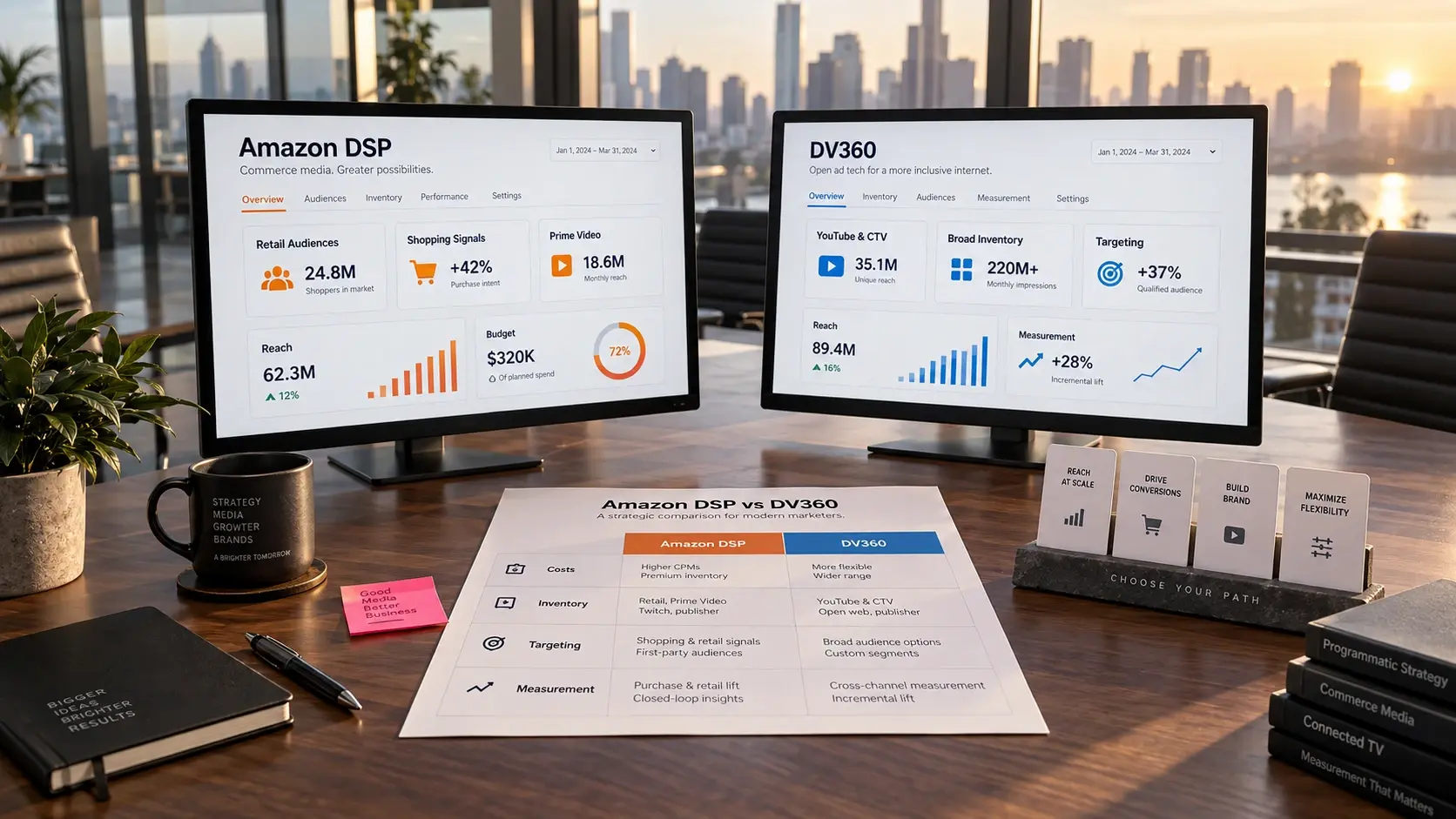

Amazon DSP and Google Display & Video 360 are enterprise DSPs with different strengths. Amazon is differentiated by commerce and entertainment signals; DV360 by YouTube, Google’s advertising ecosystem and broad programmatic workflows.
The right choice is the platform with the most useful audience signal, required inventory, workable access terms and suitable measurement.
Quick answer: Neither platform is universally better. Choose Amazon DSP when Amazon shopping, browsing and streaming signals or Prime Video supply are central. Choose DV360 when YouTube, Google Marketing Platform integrations and broad exchange buying matter most. Many mature advertisers use both, assigning each platform a distinct audience, inventory and measurement role.
How do Amazon DSP and DV360 compare at a glance?
Decision factor | Amazon DSP | DV360 | Practical advantage |
|---|---|---|---|
Distinctive data | Amazon browsing, shopping and streaming signals; advertiser and third-party audiences | Google audience products, advertiser first-party lists and Google ecosystem integrations | Amazon for commerce-informed audiences; DV360 for Google-centered activation |
Signature inventory | Prime Video, Fire TV, Twitch, Amazon properties and eligible third-party supply | YouTube and partners plus broad open-auction, private marketplace and programmatic guaranteed inventory | Depends on the must-have publisher or screen |
Non-endemic use | Available to brands that do not sell on Amazon | Available across supported advertiser categories and markets | Both can work; Amazon adds value when its signals reveal relevant intent |
Buying models | Self-service and Amazon-managed service; partner routes may also be available | Usually accessed through a Google Marketing Platform relationship or DV360 partner | Access terms often decide feasibility |
Public minimum | Amazon says managed service typically requires $50,000 per campaign, varying by country; no universal public self-service minimum | Google does not publish one universal minimum for every DV360 access arrangement | Compare the exact contract, not a generic platform claim |
Platform fee | Contract- or provider-specific | Google documents a DV360 fee calculated as a percentage of media spend, with rates depending on contract and inventory type | Request a transparent, line-itemized proposal |
Measurement strength | Amazon DSP reporting and eligible Amazon Marketing Cloud analysis | DV360 reporting with Campaign Manager 360 and other Google Marketing Platform workflows | Select according to the source of truth used by the advertiser |
Best default fit | Retail, consumer intent, Prime Video and Amazon-informed reach | YouTube, multi-exchange buying and Google-centered media operations | Use the decision matrix below |
Which is better, Amazon DSP or DV360?
Amazon DSP is usually the stronger first choice when the campaign depends on Amazon’s commerce, browsing or streaming signals, or when Prime Video and other Amazon-owned environments are strategic. This can apply to endemic sellers and non-endemic advertisers such as automotive, travel, financial services or telecom brands.
DV360 is usually the stronger first choice when YouTube is the anchor channel, when the team needs broad exchange and deal workflows, or when media operations rely heavily on Campaign Manager 360 and other Google Marketing Platform products.
Define “better” against four questions:
Which platform has the audience signal most closely related to the desired outcome?
Which platform provides the inventory that is genuinely non-negotiable?
Which access and fee model fits the budget and operating team?
Which measurement environment can credibly evaluate success?
How do costs, fees and minimum spends differ?
Neither Amazon DSP nor DV360 has one public CPM or all-in price that applies to every advertiser. Total cost can include media, platform or access fees, management, audience data, ad serving, verification, measurement and creative production.
Amazon DSP costs
As of September 28, 2026, Amazon’s official product page states that its managed-service option typically requires a $50,000 minimum campaign spend, although the minimum can vary by country. This should not be described as a universal minimum for every Amazon DSP campaign. Self-service and partner-access arrangements have separate eligibility and commercial terms, and Amazon does not publish one universal self-service rate card.
For a complete cost breakdown, see Amazon DSP Pricing & Managed Service (2026).
DV360 costs
Google does not publish one universal DV360 minimum or flat monthly price. Google’s documentation explains that the DV360 fee is calculated as a percentage of media spend under the applicable contract and can differ by inventory type. Access may be direct or provided through a partner, whose minimum, markup and support model can materially change total cost.
See DV360 vs Independent DSPs and the broader DSP Pricing comparison before evaluating a proposal.
What buyers should compare
Ask both providers to quote the same cost stack:
Total campaign cost = media + platform/access + data + ad serving + verification + measurement + management + creative
A lower platform fee does not guarantee lower total cost. Request a forecast showing reach, frequency, CPM and all fees for the same geography, audience, format and flight.
How does inventory differ between Amazon DSP and DV360?
Amazon DSP combines Amazon-owned environments with eligible third-party supply. Amazon’s official product page lists formats including display, online video, streaming TV, audio and physical-store advertising. It identifies supply such as Prime Video, Fire TV, Twitch, Amazon.com and thousands of third-party sites and apps through direct publisher integrations and exchanges, with regional availability caveats.
DV360 supports display, video, audio and connected-TV buying across public auctions, private marketplaces and direct or guaranteed deals. Its defining inventory advantage is YouTube and partners. Google’s current documentation lists skippable and non-skippable in-stream, bumper, in-feed, Shorts, Masthead, Pause and audio formats, subject to campaign type and eligibility.
For CTV, create a publisher-level map and classify each property as open auction, private marketplace, programmatic guaranteed or platform-owned. The Premium CTV Inventory Map is a starting point; confirm availability for the market and seat.
Which platform has better targeting and first-party data options?
Amazon DSP’s distinctive advantage is the use of Amazon signals informed by browsing, shopping and streaming activity. Amazon groups its targeting into Amazon Audiences, advertiser audiences and third-party audiences. It also states that Amazon DSP is available to advertisers that do and do not sell products on Amazon.
DV360 offers demographics, geography, inventory, contextual controls, first- and third-party audience lists, affinity and in-market audiences, plus advertiser data workflows. Certain features differ by inventory. For example, Google’s documentation says Customer Match for YouTube and partners targets signed-in YouTube users and supports specific YouTube formats. First-party audience functionality on non-YouTube CTV can have separate limitations.
Compare data portability and usability:
What identifiers and consent basis does the advertiser have?
Can the required list be activated on the intended inventory?
What match-rate and minimum-size rules apply?
Can customers, converters or existing subscribers be excluded?
Can exposure and conversion data be analyzed in the advertiser’s chosen environment?
Choose the signal closest to the behavior, life stage or content relevant to the campaign—not the platform claiming “more data.”
Is Amazon DSP useful for brands that do not sell on Amazon?
Yes. Amazon explicitly states that Amazon DSP is available to non-endemic advertisers. A travel brand could use audiences informed by relevant browsing and shopping behavior; an automotive brand could reach in-market consumers; a financial-services brand could build awareness across streaming TV and premium publisher inventory. Exact segments, policies and availability depend on market and account.
If Amazon’s signals create a meaningful audience unavailable elsewhere, or Prime Video is strategic, Amazon DSP may be justified without an Amazon retail objective. Otherwise, DV360 may provide a simpler route.
Which platform is stronger for YouTube and connected TV?
Choose DV360 when YouTube is central and the advertiser needs enterprise-level YouTube planning, frequency, reporting or integration with a broader Google media workflow. DV360 also provides access to non-YouTube CTV inventory through supported exchanges and deals, but publisher access varies.
Choose Amazon DSP when Prime Video, Fire TV, Twitch or Amazon-informed streaming audiences are central. Amazon also provides third-party streaming-TV supply, subject to region and account. Neither platform should be assumed to reach every premium streaming service in every market.
For CTV, compare:
the exact publisher and app list;
auction versus guaranteed access;
household or device-level frequency controls;
creative approval and technical specifications;
supply-path transparency;
reach and frequency reporting;
lift-study or conversion-measurement eligibility.
How do measurement and reporting compare?
Amazon DSP provides campaign reporting and can connect eligible advertisers to Amazon Marketing Cloud for event-level analysis in a privacy-safe clean-room environment. This is valuable when teams need custom path, reach, frequency or audience analysis across Amazon Ads activity. Eligibility, implementation and data availability must be confirmed.
DV360 offers platform reporting and can operate with Campaign Manager 360, Floodlight and other Google Marketing Platform workflows. This can simplify trafficking, deduplication and conversion reporting for organizations already using Google’s stack. Integration quality still depends on correct account linking, tagging, attribution settings and governance.
Before launch, define the business outcome, attribution window, source of truth, deduplication method and experiment design. Platform-attributed conversions are not proof of incrementality.
What is the 2026 platform decision matrix?
Campaign requirement | Recommended starting point | Why |
|---|---|---|
Amazon retail or shopping signals are essential | Amazon DSP | Amazon’s distinctive first-party commerce signals are central to the hypothesis |
Prime Video is a must-have environment | Amazon DSP | Direct Amazon ecosystem relevance, subject to market availability |
YouTube is the primary video channel | DV360 | Enterprise YouTube formats and Google-centered workflows |
Broad multi-exchange display/video buying | DV360 | Mature exchange, deal and inventory-management workflows |
Non-endemic brand wants Amazon-informed audiences | Amazon DSP | Amazon officially supports advertisers that do not sell on Amazon |
Team depends on CM360/Floodlight operations | DV360 | Closer fit with the existing Google Marketing Platform stack |
Advertiser needs custom Amazon Ads clean-room analysis | Amazon DSP | Eligible Amazon Marketing Cloud workflows |
Budget cannot meet Amazon managed-service terms | DV360 partner or an eligible Amazon self-service/partner route | Compare actual access terms; do not treat $50,000 as a universal Amazon DSP minimum |
YouTube plus Prime Video are both strategic | Both, with separated roles | Avoid duplicated open-web buying and define cross-platform measurement first |
The required publisher is available through only one approved deal path | Platform with confirmed access | Inventory verification overrides generic platform preference |
This matrix is AdGeeks planning guidance, not a platform guarantee. Validate market, seat, policy, audience and inventory eligibility before contracting.
When should advertisers use both Amazon DSP and DV360?
A two-DSP strategy works when each platform has a distinct job: for example, DV360 for YouTube and selected deals, Amazon DSP for Prime Video and Amazon-informed audiences. The objective is additive reach, not duplicated buying.
Before activating both platforms:
Assign exclusive inventory or audience roles where possible.
Exclude existing customers consistently.
Align campaign dates, naming, creative versions and conversion definitions.
Set platform-level frequency controls and monitor combined exposure with the best available measurement method.
Use neutral experiments or analytics where possible; do not add platform-attributed conversions together as if they were deduplicated.
If the budget cannot produce meaningful reach and learning in both DSPs, concentrate spend in the platform with the strongest hypothesis.
What should you ask before choosing a DSP partner?
Request written answers:
Is the account self-service, managed or hybrid?
Who owns the advertiser account, campaigns and historical data?
What is the minimum, and is it per campaign, month, quarter or contract?
Which fees sit above media spend?
Which exchanges, publishers, audiences and measurement products are enabled in the target country?
Can the team export granular reports and access the platform directly?
Who handles policy, creative, deal, tracking and delivery issues?
What happens to campaigns and data if the relationship ends?
AdGeeks provides access and managed-service options across Amazon DSP and DV360. Request a platform recommendation based on your market, budget, inventory requirements, first-party data and measurement stack.
Frequently asked questions
Which is better, Amazon DSP or DV360?
Amazon DSP is usually better when Amazon shopping, browsing or streaming signals and Prime Video are central. DV360 is usually better when YouTube, broad programmatic deal access and Google Marketing Platform workflows matter most. The strongest choice depends on the required audience, inventory, geography, access terms and measurement plan—not on a universal platform ranking.
Is Amazon DSP more expensive than DV360?
Not inherently. Amazon and Google do not publish one universal all-in CPM for every advertiser. Amazon states that managed service typically requires a $50,000 campaign minimum, varying by country, but that is not a universal self-service minimum. DV360 pricing depends on the contract or partner. Compare identical media plans and every fee layer.
Can non-Amazon sellers use Amazon DSP?
Yes. Amazon’s official DSP page says the platform is available to advertisers that sell on Amazon and those that do not. Non-endemic brands can use eligible Amazon audiences, Amazon-owned environments and third-party supply. The business case is strongest when Amazon’s signals or inventory add something that the advertiser cannot obtain more efficiently elsewhere.
Does DV360 have a minimum spend?
Google does not publish one universal minimum that applies to every DV360 advertiser and access route. A direct relationship or partner may set its own commercial requirements. Ask whether the minimum applies to media, total billing, one campaign or a recurring period, and compare platform, partner, data, ad-serving and management fees separately.
Which platform is better for CTV advertising?
DV360 is a strong starting point for YouTube-led CTV and supported third-party exchanges or deals. Amazon DSP is a strong starting point for Prime Video, Fire TV and Amazon-informed streaming audiences. The correct answer depends on the required publishers, country, buying route, frequency controls and measurement eligibility. Confirm supply at publisher level before launch.
Can advertisers use Amazon DSP and DV360 together?
Yes. A combined plan can use DV360 for YouTube and selected deals while Amazon DSP handles Prime Video and Amazon-informed audiences. Define exclusive roles, align conversion rules and monitor duplicated reach. Do not simply add each platform’s attributed conversions; use deduplicated analytics, experiments or a clearly governed source of truth where available.
Which platform is better for first-party data activation?
Both can activate advertiser data, but compatibility differs by identifier, inventory, market and account. DV360 can use advertiser lists and Google-centered workflows; Amazon DSP supports advertiser audiences and Amazon Marketing Cloud use cases for eligible accounts. Compare consent, match requirements, exclusions, measurement and the exact inventory on which the audience can serve.
Sources
Amazon DSP product page - product positioning, supply, audiences, non-endemic eligibility, buying options and managed-service minimum; accessed September 28, 2026.
About targeting in Display & Video 360 - inventory, audience, content and technology targeting; accessed September 28, 2026.
YouTube & partners ad formats - current supported YouTube formats; accessed September 28, 2026.
Customer Match for YouTube & partners - YouTube Customer Match scope; accessed September 28, 2026.
Partners in Display & Video 360 - account structure, DV360 fee and partner costs; accessed September 28, 2026.